HEALTH BENIFITS AND IMPORTAND ROLE OF HUMAN HEALTH GOOD SOURCE OF MINERALS AND CONTAIN MORE VITAMINS SEASAME SEEDS AND OILS
HEALTH BENIFITS AND IMPORTAND ROLE OF HUMAN HEALTH GOOD SOURCE OF MINERALS AND CONTAIN MORE VITAMINS SEASAME SEEDS AND OILS
Introduction
Etymology
Origins and history
Botany
Agriculture
Cultivation
Nutrition
Composition
Health effects
Culinary use
15 Health and Nutrition Benefits of Sesame Seeds

Sesame Sesamum indicum) is a plant in the genus Sesamum, also called benne.[4] Numerous wild relatives occur in Africa and a smaller number in India. It is widely naturalized in tropical regions around the world and is cultivated for its edible seeds, which grow in pods. World production in 2018 was 6 million tonnes (5.9 million long tons), with Sudan, Myanmar, and India as the largest producers.
Sesame seed is one of the oldest oilseed crops known, domesticated well over 3,000 years ago. Sesamum has many other species, most being wild and native to sub-Saharan Africa. S. indicum, the cultivated type, originated in India. It tolerates drought conditions well, growing where other crops fail. Sesame has one of the highest oil contents of any seed. With a rich, nutty flavor, it is a common ingredient in cuisines around the world. Like other foods, it can trigger allergic reactions in some people and is one of the nine most common allergens outlined by the Food and Drug Administration.
Etymology
The word "sesame" is from Latin sesamum and Greek σήσαμον: sēsamon; which in turn are derived from ancient Semitic languages such as Akkadian šamaššamu.[5] From these roots, words with the generalized meaning "oil, liquid fat" were derived.[6]
The word "benne" was first recorded in English in 1769; it comes from the African American creole Gullah benne, which in turn derives from Malinke bĕne.[7][4]
Origins and history

Sesame seed is considered to be the oldest oilseed crop known to humanity.[8] The genus has many species, and most are wild and native to sub-Saharan Africa.[9] Sesamum indicum, the cultivated type,[10][11] originated in India.[6][12][9]
Archaeological remnants of charred sesame dating to about 3500-3050 BC shows that sesame was domesticated in the Indian subcontinent at least 5500 years ago.[13][14] The archaeobotanist Dorian Q. Fuller states that trading of sesame between Mesopotamia and the Indian subcontinent occurred by 2000 BC.[15] It is possible that the Indus Valley civilization exported sesame oil to Mesopotamia, where it was known as ilu in Sumerian and ellu in Akkadian, similar to the Dravidian languages Kannada and Malayalam eḷḷu, Tamil eḷ.[16]
Sesame was cultivated in ancient Egypt.[17] Egyptians called it sesemt, and it is included in the list of medicinal drugs in the scrolls of the c. 1550 BC Ebers Papyrus. Excavations of King Tutankhamen uncovered baskets of sesame among other grave goods, suggesting that sesame was present in Egypt by 1350 BC.[18] Sesame was grown and pressed to extract oil at least 750 BC in the empire of Urartu.[14] Others believe it may have originated in Ethiopia.[19]
Historically, sesame was favored for its ability to grow in areas that do not support the growth of other crops. It is a robust crop that needs little farming support—it grows in drought conditions, in high heat, with residual moisture in soil after monsoons are gone or even when rains fail or when rains are excessive. It can be grown by subsistence farmers at the edge of deserts, earning it the name of survivor crop from the sesame breeder Derald Ray Langham.[20]
Botany
Sesame is a perennial plant growing 50 to 100 cm (1 ft 8 in to 3 ft 3 in) tall, with opposite leaves 4 to 14 cm (2 to 6 in) long with an entire margin; they are broad lanceolate, to 5 cm (2.0 in) broad, at the base of the plant, narrowing to just 1 cm (0.39 in) broad on the flowering stem. The flowers are tubular, 2.5 to 3 cm (0.98 to 1.18 in) long.[21] The flowers vary in colour, from white to pink or purple.[22]
The fruit is a capsule, normally pubescent. The length of the fruit capsule varies from 2 to 3 cm (0.79 to 1.18 in), its width varies between 0.6 and 1.2 cm (0.24 and 0.47 in); there are four locules. The seeds are either white or black.[21]
Sesame seeds are small. Their sizes vary widely by cultivar. Typically, the seeds are 3 to 4×2×1 mm (0.12 to 0.16×0.08×0.04 in). The seeds are ovate, slightly flattened, and somewhat thinner at the eye of the seed (hilum) than at the opposite end. The mass of 100 seeds sampled from a market in Ibadan, Nigeria is 0.203 g, meaning that one gram of sesame consists of around 493 seeds.[23]
Sesame was described as the species Sesamum indicum by Carl Linnaeus in 1753.[24]
-
 Plant
Plant -
 Flowers and seed capsules on plant
 -
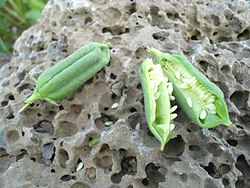 Seed capsule
 -
 Magnified image of white sesame seeds


Agriculture
Cultivation
Sesame varieties have adapted to many soil types. The high-yielding crops do best on fertile, well-drained, soils with a neutral pH. However, these have a low tolerance for soils with high salt and water-logged conditions. Commercial sesame crops require 90 to 120 frost-free days. Warm conditions above 23 °C (73 °F) favor growth and yields. While sesame crops can grow in poor soils, the best yields come from properly fertilized farms.[14][25]
Flowering depends on photoperiod and cultivar. The photoperiod also affects the seed's oil content: increased photoperiod increases oil content. The oil content of the seed is inversely proportional to its protein content.[14] Sesame is drought-tolerant, in part due to its extensive root system. However, it requires adequate moisture for germination and early growth. While the crop survives drought and the presence of excess water, the yields are significantly lower in either condition. Moisture levels before planting and flowering affect yield the most.[14] Most commercial cultivars of sesame are intolerant of waterlogging. Rainfall late in the season prolongs growth and increases loss to dehiscence, when the seedpod shatters, scattering the seed. Wind can also cause shattering at harvest.[14]
Processing
Sesame seeds are protected by a capsule that bursts when the seeds are ripe. The time of this bursting, or "dehiscence", tends to vary, so farmers cut plants by hand and place them together in an upright position to continue ripening until all the capsules have opened. The 1943 discovery of an indehiscent mutant (analogous to nonshattering in cereals) led breeders to try to create a high-yield variety that does not drop its seeds. Despite some progress, dehiscence continues to limit production.[14] Agronomists in Israel are working on modern cultivars of sesame that can be harvested by mechanical means.[26]
Since sesame seed is small and flat, it is hard to dry after harvest because the seeds pack closely together, impeding the flow of air in a drying bin. Therefore, the harvested seeds need to be as dry as possible, and then stored at 6% moisture or less. Moist seed stores can rapidly heat up and become rancid.[27]
Production
| Sesame seed production 2022, in tonnes | |
|---|---|
 Sudan Sudan |
1,231,701 |
 India India |
788,740 |
 Myanmar Myanmar |
760,926 |
 Tanzania Tanzania |
700,000 |
 Nigeria Nigeria |
450,000 |
 Burkina Faso Burkina Faso |
208,795 |
 Niger Niger |
104,088 |
| World | 6,741,479 |
| Source: FAOSTAT of the United Nations[28] | |
In 2022, world production of sesame seeds was 6.7 million tonnes, led by Sudan, India, and Myanmar, which together accounted for 41% of the total (table).[28]
The white and other lighter-colored sesame seeds are common in Europe, the Americas, West Asia, and the Indian subcontinent. The black and darker-colored sesame seeds are mostly produced in China and Southeast Asia.[29]
In the United States most sesame is raised by farmers under contract to Sesaco, which also supplies proprietary seed.[30][31]
Trade
Japan is the world's largest sesame importer. Sesame oil, particularly from roasted seed, is an important component of Japanese cooking and traditionally the principal use of the seed. China is the second-largest importer of sesame, mostly oil-grade. China exports lower-priced food-grade sesame seeds, particularly to Southeast Asia. Other major importers are the United States, Canada, the Netherlands, Turkey, and France.[32]
Sesame seed is a high-value cash crop. Prices ranged between US$800 and 1,700 per tonne (810 and 1,730/long ton) between 2008 and 2010.[33][34] Prices depend on perceived quality, based on factors such as the seed's appearance, freedom from impurities, oil content of at least 40%, and sorting by size and colour.[27]
Nutrition
Composition
| Nutritional value per 100 grams | |||
|---|---|---|---|
| Energy | 2,400 kJ (570 kcal) | ||
23.4 | |||
| Sugars | 0.3 | ||
| Dietary fiber | 11.8 | ||
49.7 | |||
| Saturated | 7.0 | ||
| Monounsaturated | 18.8 | ||
| Polyunsaturated | 21.8 | ||
17.7 | |||
|
| |||
| |||||||||||||||||||||||||||||||||||||||||||
| Other constituents | Quantity | ||||||||||||||||||||||||||||||||||||||||||
|---|---|---|---|---|---|---|---|---|---|---|---|---|---|---|---|---|---|---|---|---|---|---|---|---|---|---|---|---|---|---|---|---|---|---|---|---|---|---|---|---|---|---|---|
| Water | 4.7 g | ||||||||||||||||||||||||||||||||||||||||||
| †Percentages estimated using US recommendations for adults,[35] except for potassium, which is estimated based on expert recommendation from the National Academies[36] | |||||||||||||||||||||||||||||||||||||||||||
Dried whole sesame seeds are 5% water, 23% carbohydrates, 50% fat, and 18% protein (table). In a reference amount of 100 g (3.5 oz), dried sesame seeds supply 570 calories of food energy, and are a rich source (20% or more of the Daily Value, DV) of several B vitamins and dietary minerals, such as calcium, iron, and magnesium (all 75% or more of the DV, table).
The byproduct that remains after oil extraction from sesame seeds, also called sesame oil meal, is rich in protein (35–50%) and is used as feed for poultry and livestock.[14][27][29]
As many seeds do, whole sesame seeds contain a significant amount of phytic acid, which is considered an antinutrient in that it binds to certain nutritional elements consumed at the same time, especially minerals, and prevents their absorption by carrying them along as they pass through the small intestine. Heating and cooking reduce the amount of the acid in the seeds.[37] The seeds contain the lignans sesamolin, sesamin, pinoresinol, and lariciresinol.[38][39]
Health effects
A meta-analysis showed that sesame consumption produced small reductions in both systolic and diastolic blood pressure;[40] another demonstrated improvement in fasting blood glucose and hemoglobin A1c.[41] Sesame oil studies reported a reduction of oxidative stress markers and lipid peroxidation.[42]
Possible harms
Allergy
Sesame can trigger the same allergic reactions, including anaphylaxis, as seen with other food allergens.[43] A cross-reactivity exists between sesame and peanuts, hazelnuts and almonds.[43][44] In addition to food products derived from sesame seeds, such as tahini and sesame oil, persons with sesame allergies are encouraged to be aware of foods that may contain sesame, such as baked goods.[43][44][45] In addition to food sources, individuals allergic to sesame have been warned that a variety of non-food sources may also trigger a reaction to sesame, including cosmetics and skin-care products.[45]
Prevalence of sesame allergy is on the order of 0.1–0.2%, but higher in countries in the Middle East and Asia where consumption is more common as part of traditional diets.[43] In the United States, sesame allergy possibly affects 1.5 million individuals.[46][47]
Canada requires sesame to be labelled as an allergen.[45] In the European Union, identifying the presence of sesame, along with 13 other foods, either as an ingredient or an unintended contaminant in packaged food is compulsory.[48] In the United States, the FASTER Act mandated labeling[49] from 2023.[50][51]
Contamination
Contamination by Salmonella, E.coli, pesticides, or other pathogens may occur in large batches of sesame seeds, such as in September 2020 when high levels of a common industrial compound, ethylene oxide, was found in a 250-tonne shipment of sesame seeds from India.[52][53] After detection in Belgium, recalls for dozens of products and stores were issued across the European Union, totaling some 50 countries.[52][53] Products with an organic certification were also affected by the contamination.[54] Regular governmental food inspection for sesame contamination, as for Salmonella and E. coli in tahini, hummus or seeds, has found that poor hygiene practices during processing are common sources and routes of contamination.[55]
Culinary use
Sesame seed is a common ingredient in many cuisines. Sesame seed cookies called Benne wafers, both sweet and savory, are popular in places such as Charleston, South Carolina.[56] Sesame seeds, also called benne, were brought into 17th-century colonial America by enslaved West Africans.[57] The whole plant was used in West African cuisine. The seeds thickened soups and puddings, or were roasted and infused to produce a coffee-like drink.[18] Oil from the seeds substituted for butter, and served as a shortening for cakes.[18] The leaves on mature plants, which are rich in mucilage, can be used as a laxative as well as a treatment for dysentery and cholera.[58] After arriving in North America, the plant was grown by slaves as a subsistence staple to supplement their weekly rations.[59] In Caribbean cuisine, sugar and white sesame seeds are combined into a bar resembling peanut brittle and sold in stores and street corners, like Bahamian Benny cakes.[60]
In Asia, sesame seeds are sprinkled onto sushi-style foods.[61] In Japan, whole seeds are found in many salads and baked snacks, and tan and black sesame seed varieties are roasted and used to make the flavouring gomashio.[62] Ground black sesame and rice form zhimahu, a Chinese dessert and breakfast dish.[63] The seeds and oil are used extensively in India, where sesame seeds mixed with heated jaggery, sugar, or palm sugar are made into balls and bars similar to peanut brittle or nut clusters and eaten as snacks, such as chikki.[64]
Sesame is a common ingredient in Middle Eastern cuisine. The seeds are made into tahini paste and sweet halva. It is a common component of the Levantine spice mixture za'atar, popular throughout the Middle East.[65][66]
In Southern Italian cuisine, traditional sesame seed confections are one of many culinary remnants of the Arabic period. These include a brittle-style torrone served at Christmas known as giurgiulena (from the Arabic juljulàn) and a lightly sweet, seed-covered biscuit called reginelle or sesamini.[67][68] Similar sweets are found in neighboring cultures throughout the Mediterranean.[69]
Sesame oil is sometimes used for cooking, though not all varieties are suitable for high-temperature frying. The "toasted" form of the oil (as distinguished from the "cold-pressed" form) has a distinctive pleasant aroma and taste, and is sometimes used as a table condiment.
15 Health and Nutrition Benefits of Sesame Seeds
Sesame seeds have many potential health benefits. For instance, they may protect against heart disease, diabetes, and arthritis. But you may need to eat significant amounts — a small handful per day — to gain health benefits.
Sesame seeds are tiny, oil-rich seeds that grow in pods on the Sesamum indicum plant. They have been used in folk medicine for thousands of years.
Unhulled seeds have the outer, edible husk intact, while hulled seeds come without the husk.
The hull gives the seeds a golden-brown hue. Hulled seeds have an off-white color but turn brown when roasted.
Here are 15 health benefits of sesame seeds.
Three tablespoons (27 grams) of unhulled sesame seeds provide 3 gramsTrusted Source of fiber, which is 11% of the Daily Value (DV)Trusted Source.
Fiber is well known for supporting digestive health. Additionally, growing evidence suggests that fiber may play a role in reducing your risk of heart disease, certain cancers, obesity, and type 2 diabetes.
SomeTrusted Source studiesTrusted Source suggest that regularly eating sesame seeds may help decrease high cholesterol and triglycerides, which are risk factors for heart disease.
Sesame seeds consist ofTrusted Source 14% saturated fat, 44% polyunsaturated fat, and 38% monounsaturated fat.
ResearchTrusted Source indicates that eating more polyunsaturated and monounsaturated fat relative to saturated fat may help lower your cholesterol and reduce heart disease risk.
What’s more, sesame seeds contain two types of plant compounds — lignans and phytosterols — that may also have cholesterol-lowering effects.
In a 2012 studyTrusted Source, when 38 people with high blood lipids ate 5 tablespoons (40 grams) of hulled sesame seeds daily for 2 months, they experienced a 10% reduction in “bad” LDL cholesterol and an 8% reduction in triglycerides compared to the placebo group.
Sesame seeds supply 4.77 gramsTrusted Source of protein per 3-tablespoon (27-gram) serving.
To maximize protein availability, opt for hulled, roasted sesame seeds. The hulling and roasting processes reduce oxalates and phytates, compounds that hamper protein digestion and absorption.
Protein is essential for your health, as it helps build everything from muscles to hormones.
Notably, sesame seeds are low in lysine, an essential amino acid more abundant in animal products. However, vegans and vegetarians can compensate by consuming high-lysine plant proteins — particularly legumes, such as kidney beans and chickpeas.
On the other hand, sesame seeds are high in methionine and cysteine, two amino acids that legumes don’t provide in large amounts.
High blood pressure is a major risk factor for heart disease and stroke.
Sesame seeds are high in magnesium, which may help lower blood pressure.
Additionally, lignans, vitamin E, and other antioxidants in sesame seeds may help prevent plaque buildup in your arteries, potentially maintaining healthy blood pressure.
In one 2011 study, people with high blood pressure consumed 2.5 grams of powdered black sesame seeds — a less common variety — in capsule form every day.
A 2020 review confirmed that sesamin, a compound found in sesame seeds and their oil, lowered systolic ventricular blood pressure in both human and animal studies.
At the end of one month, they experienced a 6% decrease in systolic blood pressure—the top number on a blood pressure reading—compared to the placebo group.
Sesame seeds — both unhulledTrusted Source and hulledTrusted Source — are rich in several nutrients that boost bone health, though the calcium is mainly in the hull.
Three tablespoons of sesame seeds boast:
| Unhulled | Hulled | |
|---|---|---|
| Calcium | 20% of the DV | 1% of the DV |
| Magnesium | 23% of the DV | 20% of the DV |
| Manganese | 29% of the DV | 15% of the DV |
| Zinc | 19% of the DV | 15% of the DV |
However, sesame seeds contain natural compounds called oxalates and phytates, antinutrients that reduce the absorption of these minerals.
Try soaking, roasting, or sprouting the seeds to limit these compounds’ impact.
One study found that sprouting reduced the concentration of phytate and oxalate by about 50% in both hulled and unhulled sesame seeds.
Sesame seeds may fight inflammation.
Long term, low-level inflammation may play a role in many chronic conditions, including obesity and cancer, as well as heart and kidney disease.
A 2014 study found that when people with kidney disease ate a mixture of 18 grams of flax seeds and 6 grams each of sesame and pumpkin seeds daily for 3 months, their inflammatory markers dropped 51‒79%.
A 2020 review of clinical trials found that sesame consumption reduced the amount of interleukin-6 (IL-6), an inflammatory protein, but did not affect the level of other inflammatory markers like C-reactive protein (CRP) or tumor necrosis factor-α (TNF-α).
A 2023 literature review found that sesamol, a lignan in sesame, effectively targets several inflammatory proteins, including IL-6 and TNF-α. More research is needed.
Sesame seeds are a good source of specific B vitamins, which are distributed both in the hull and seed.
Removing the hull may either concentrate or remove some of the B vitamins.
Three tablespoons of unhulled and hulled sesame seeds provide:
| Unhulled | Hulled | |
|---|---|---|
| Thiamine (B1) | 18% of the DV | 14% of the DV |
| Niacin (B3) | 8% of the DV | 9% of the DV |
| Vitamin B6 | 13% of the DV | 6% of the DV |
B vitamins are essential for many bodily processes, including proper cell function and metabolism.
To make red blood cells, your body needs several nutrients, including those in sesame seeds.
Three tablespoons of sesame seeds give:
| Unhulled | Hulled | Function | |
|---|---|---|---|
| Iron | 22% of the DV | 9% of the DV | An essential component of hemoglobin, which carries oxygen in your red blood cells |
| Copper | 122% of the DV | 37% of the DV | Helps make hemoglobin |
| Vitamin B6 | 13% of the DV | 6% of the DV | Helps make hemoglobin |
Soaked, roasted, or sprouted sesame seeds may increase the absorption of these minerals.
Sesame seeds are low in carbohydrates while high in protein and healthy fats, all of which may support blood sugar control.
Additionally, these seeds contain pinoresinol, a compound that may help regulate blood sugar by inhibiting the action of the digestive enzyme maltase.
Maltase breaks down the sugar maltose, which is used as a sweetener for some food products. It’s also produced in your gut from the digestion of starchy foods like bread and pasta.
If pinoresinol inhibits your digestion of maltose, this may result in lower blood sugar levels. However, human studies are needed.
Animal and human studies suggest that consuming sesame seeds may increase your blood’s overall amount of antioxidant activity.
The lignans in sesame seeds function as antioxidants, which help fight oxidative stress — a chemical reaction that may damage your cells and increase your risk of many chronic diseases.
Additionally, sesame seeds contain a form of vitamin E called gamma-tocopherol, an antioxidant that may be especially protective against heart disease.
Sesame seeds are a good source of several nutrients crucial for your immune system, including zinc, selenium, copper, iron, vitamin B6, and vitamin E.
For example, your body needs zinc to develop and activate certain white blood cells that recognize and attack invading microbes.
Keep in mind that even mild to moderate zinc deficiency can impair immune system activity.
Whole sesame seeds supply about 19% of the DV for zinc in a 3-tablespoon (27-gram) serving.
Osteoarthritis is the most common cause of joint pain and frequently affects the knees.
Several factors may contribute to arthritis, including inflammation and oxidative damage to the cartilage that cushions joints.
Research shows that sesamin, a compound in sesame seeds, has anti-inflammatory and antioxidant effects that may protect your cartilage.
In a 2-month studyTrusted Source, people with knee arthritis ate 5 tablespoons (40 grams) of sesame seed powder daily alongside drug therapy. They experienced a 63% decrease in knee pain compared to only a 22% decrease for the group on drug therapy alone.
Additionally, the sesame seed group showed greater improvement in a simple mobility test and larger reductions in certain inflammatory markers compared to the control group.
Sesame seeds are a good source of selenium, supplying 188% of the DV in a 3 tablespoon serving.
Your thyroid gland contains the highest selenium concentration of any organ in your body. This mineral plays a vital role in making thyroid hormones.
In addition, sesame seeds are a good source of iron, copper, zinc, and vitamin B6, which also support the production of thyroid hormones and aid thyroid health.
Sesame seeds contain phytoestrogens, plant compounds that are similar to the hormone estrogen.
Therefore, sesame seeds might be beneficial for women when estrogen levels drop during menopause. For example, phytoestrogens may help counteractTrusted Source hot flashes and other symptoms of low estrogen.
What’s more, these compounds may decreaseTrusted Source your risk of certain diseases — such as breast cancer — during menopause. However, further research is needed.
Sesame seeds can give a nutty flavor and subtle crunch to many dishes.
To enhance the flavor and nutrient availability of sesame seeds, roast them at 350℉ (180℃) for a few minutes, stirring periodically, until they reach a light, golden brown.
Try adding sesame seeds to:
- stir-fries
- steamed broccoli
- hot or cold cereal
- granola and granola bars
- bread and muffins
- crackers
- yogurt
- smoothies
- salads
- salad dressing
- hummus
- garnishes
You can also use sesame seed butter or tahini instead of peanut butter or hummus.
Ground sesame seeds — called sesame flour or sesame seed meal — can be used in baking, smoothies, fish batter, and more.
However, sesame allergies have become more prevalent, so you may need to take caution when cooking for groups.
.png)
"This Content Sponsored by SBO Digital Marketing.
Mobile-Based Part-Time Job Opportunity by SBO!
Earn money online by doing simple content publishing and sharing tasks. Here's how:
Job Type: Mobile-based part-time work
Work Involves:
Content publishing
Content sharing on social media
Time Required: As little as 1 hour a day
Earnings: ₹300 or more daily
Requirements:
Active Facebook and Instagram account
Basic knowledge of using mobile and social media
For more details:
WhatsApp your Name and Qualification to 9994104160
a.Online Part Time Jobs from Home
b.Work from Home Jobs Without Investment
c.Freelance Jobs Online for Students
d.Mobile Based Online Jobs
e.Daily Payment Online Jobs
Keyword & Tag: #OnlinePartTimeJob #WorkFromHome #EarnMoneyOnline #PartTimeJob #jobs #jobalerts #withoutinvestmentjob"
Comments
Post a Comment